
Rules node data fields
Authorization type rules applicable to a transaction are included as part of the data fields of the FAST message. These fields are included in active FAST, passive FAST and FAST lite.
These data fields are:
"Rule_Id": (numerical value),"Rule_Type": (2 alpha identifier of the type of rule),"Rule_Check_Result": (numerical value between -1 and 20),"Pattern_Result": (true or false),"Current_Txn_Amt_Deviation": (financial value),"Aggregate_Deviation": (financial value),"Count_Deviation": (count value)
We use the following example rules to showcase example scenarios to assist with understanding:
Rule 1: If the current txn is a cash withdrawal of more than $1000.00 and there are 5 or more POS transactions at gas pump during the week, then trigger the rule.
Rule 2: If the current txn is made at Starbucks (blocked merchant), trigger the rule.
Rule 3: Trigger the rule if the total amount for eCommerce txns for 24 hours exceeded 2000 GBP, including the current txn.
Data fields explained
Click on the options below to find out more about each of the data fields:
Rule Id
Unique identifier of group or card rule. Numerical value.
Rule_Type
Rule type identifies at what type of event the rule functions. For transaction-based rules the following values are applicable:
Rule_Type value | Definition | Event |
|---|---|---|
AU | Authorization | Rule functions prior to the final approve/decline decision. |
ST | Stand-in | If rule conditions are met - the transaction is then made STIP eligible. This means that Paymentology will stand in for the client if the value store is unreachable. |
DA | Deactivated | Rule is not active, therefore the rule is not functioning at any specific event. |
Rule_Check_Result
The table below provides further context.
Rule_Check_Result | Description | Rule triggered | Pattern result value | Example scenario |
|---|---|---|---|---|
0 | The transaction does not match the rule. No historical check is required. Rule is not triggered | No | False | If the current txn IS a POS (purchase), then the CURRENT PATTERN is not satisfied, and no historical data check is required. Rule is not triggered. |
1 | The transaction matches the rule. Historical check was performed. Rule is not triggered | No | True | If the current txn IS indeed a withdrawal for more than $1000.00, then the CURRENT PATTERN is satisfied, and historical data check is performed. If there are less than 5 fill-ups, then the rule will NOT be triggered |
2 | The card / account state do not match the rule. Neither current transaction details check, nor historical checks are required. Rule is not triggered | No | False | The card state is determined for any transaction. Rules are also able to engage the cards current state. If the pattern for card state is engaged, and the current card's state is no match, then returning code is 2. |
3 | The merchant pattern does not match the rule. Historical check is not required. Rule is not triggered | No | False | In this instance we use Rule 2 as the example. IF the current txn is made at Pret that does not satisfy the rule then the returning code is 3. |
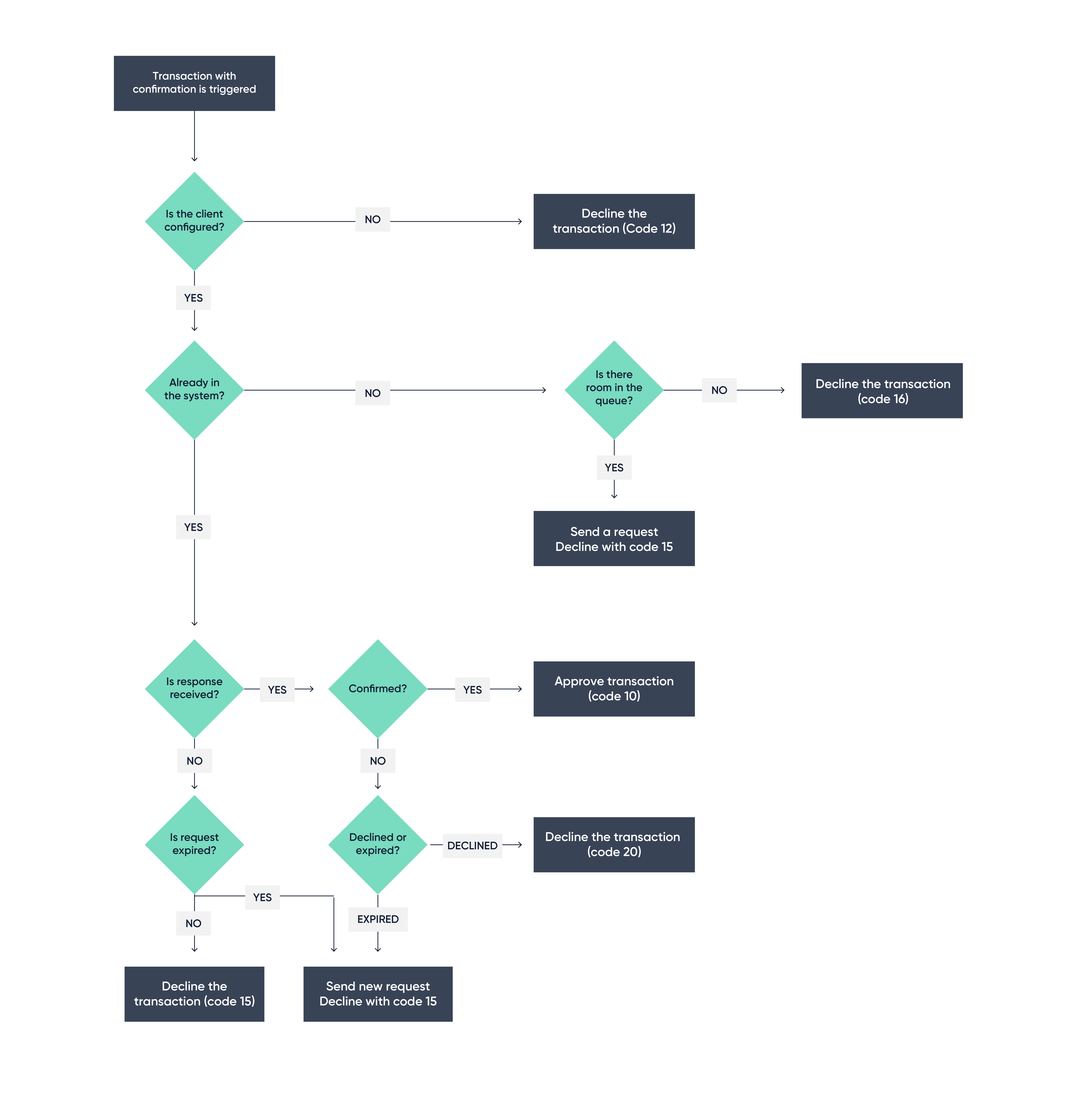
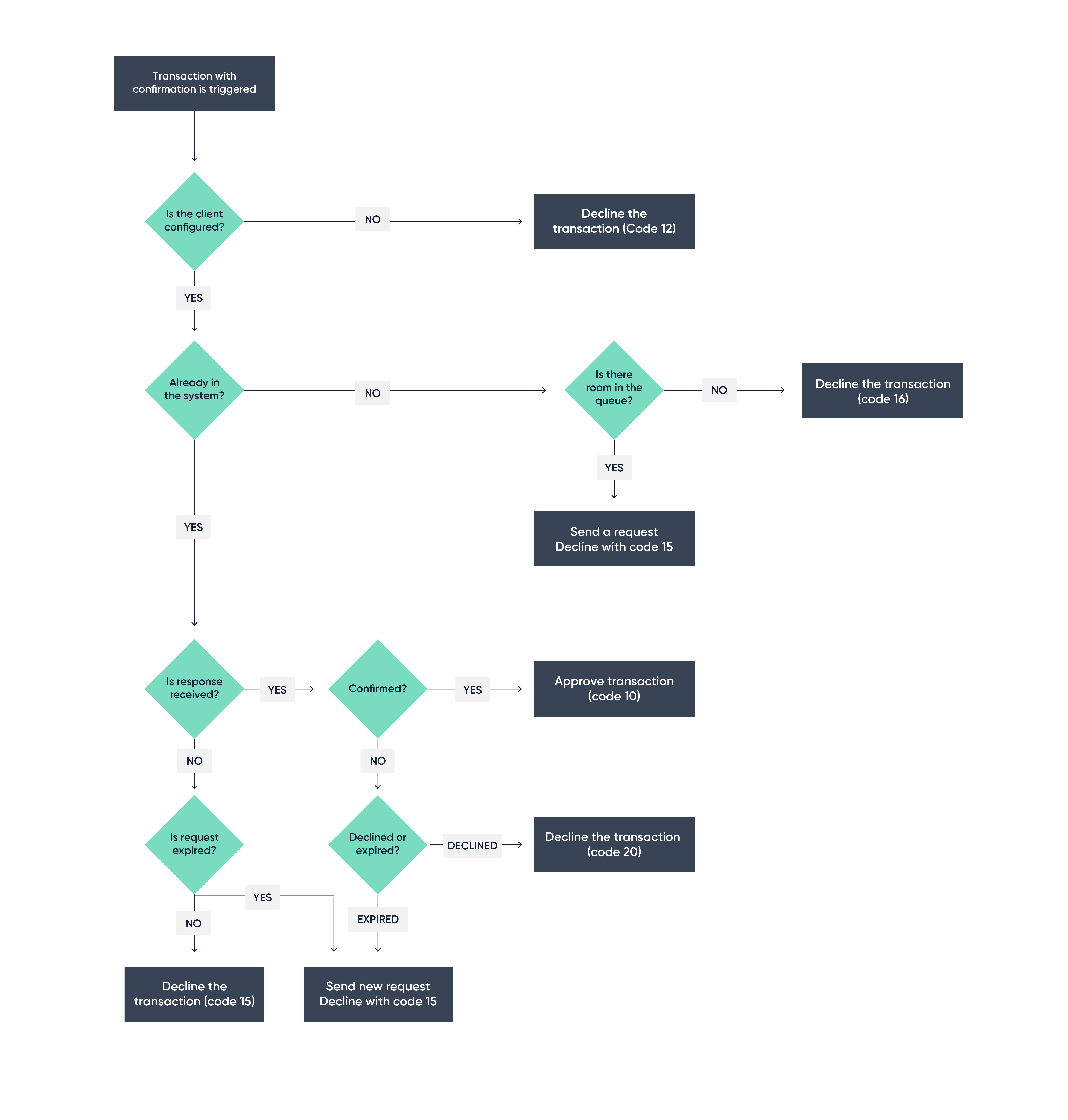
10 | The transaction was confirmed by the cardholder. The rule is triggered but will be processed as cardholder has authenticated transaction. | No | False | There is mechanism within the engine to allow for transactions to bypass rule if confirmation form the cardholder has been received. IF the current txn IS indeed a withdrawal of $1000.01, then the rule will be triggered. (13). If cardholder then confirms that the transaction is in fact legitimate, then they are advised to make transaction again. This time the transaction would proceed. |
11 | The transaction matches the rule. No historical data lookup is required. Rule triggered | Yes | True | IF the current txn IS indeed a withdrawal of $1000.01, then the rule will be triggered. |
12 | The transaction data plus historical data lookup trigger the rule | Yes | True | If the current txn IS indeed a withdrawal for more than $1000.00, then the CURRENT PATTERN is satisfied, and historical data check is performed. If there are 5 fill-ups, then the rule will be triggered. |
13 | A Confirmation Request has to be sent. But an Error Occurred during this process. Rule triggered | Yes | True | IF the current txn IS indeed a withdrawal of $1000.01, then the rule will be triggered and IF confirmation request is engaged, code 13 will be present. IF second attempt was made after receiving confirmation, the rule on the second attempt would result in 10. |
14 | The merchant is currently blocked. Transaction data triggers the rule. A special action has to be performed | Yes | True | IF the current txn IS made at a Starbucks, then the rule is triggered. Special actions include the ability to ‘dynamically block’ a merchant, meaning the merchant can be blocked for specific time windows. |
15 | A Confirmation Request was sent. The transaction is still waiting for confirmation | Yes | True | IF the current txn IS indeed a withdrawal of $1000.01, then the rule will be triggered and IF confirmation request is engaged, code 13 will be present. IF second attempt was made and no confirmation had taken place, the rule on the second attempt would result in 15. |
16 | The number of pending/active Transaction Confirmation Requests is already reached its maximum | Yes | True | Maximum limits of pending confirmation requests are able to be defined, therefore this code is applicable after preceeding txn has had a rule check result of 15. |
17 | Uniqueness violation occurred when filling in the transaction logs. Rule is triggered. | Yes | True | Not currently applicable |
20 | The transaction was declined by the cardholder. The transaction must be declined | Yes | True | IF the current txn IS indeed a withdrawal of $1000.01, then the rule will be triggered. (13). If cardholder then confirms the txn is NOT legitimate and another txn attempt is made, code 20 is applicable. |
| Negative value | Negative exit code means that the rule check was aborted because of various errors | No | False | This value is only applicable in the event of error. |
Pattern_Result
Pattern result indicates whether the current transaction pattern rule parameters have been met. This does not necessarily indicate the rule has been triggered, as the rule may require historical data check(s).
Pattern_Result | Description |
|---|---|
True | The CURRENT transaction pattern parameters have been met on a rule |
False | The CURRENT transaction pattern parameters have NOT been met on a rule |
Therefore, if we use the example rule below we can understand scenarios and the corresponding pattern result:
Rule 1: If the current txn is a cash withdrawal of more than $1000.00 and there are 5 or more POS transactions at gas pump during the week, then trigger the rule.
| Example scenario | Pattern_Result |
|---|---|
| If the current txn is a cash withdrawal of $999, then the current transaction pattern is not satisfied. | False |
| If the current txn is a purchase of $1010, then the current transaction pattern is not satisfied. | False |
| If the current txn is a withdrawal of $1010, then the current transaction pattern is satisfied. | True |
Current_Txn_Amt_Deviation
Current transaction amount deviation is defined as the financial amount the current transaction exceeds the financial value associated with a triggered rule.
Therefore, if a triggered rule does not have any financial amount pattern parameters applicable to the current transaction or does not exceed the financial value of the rule this field will result in a 0.
We use the same example rule for understanding:
Rule 1: If the current txn is a cash withdrawal of more than $1000.00 and there are 5 or more POS transactions at gas pump during the week, then trigger the rule.
| Example scenario | Current_Txn_Amt_Deviation |
|---|---|
| If the current txn is a cash withdrawal of $999 and there has been 5 POS transactions at gas pump during the week. | 0 |
| If the current txn is a purchase of $1010 and there has been 5 POS transactions at gas pump during the week. | 0 |
| If the current txn is a withdrawal of $1010 and there has been 5 POS transactions at gas pump during the week. | 10 |
| If the current txn is a withdrawal of $1000.09 and there has been 5 POS transactions at gas pump during week | 0.09 |
Aggregate_Deviation
Aggregate deviation is defined as the financial value difference of a rule involving cumulative financial values. This field will contain a value other than 0 (+ve or -ve) if the current pattern of the rule is satisfied.
Note: the rule itself may not necessarily have triggered. However, the pattern result must be true for a value other than 0.
If a triggered rule does not have any cumulative financial amount than aggregate deviation will remain as 0.
We use an example rule for understanding:
Rule 3: Trigger the rule if the total amount for eCommerce txns for 24 hours exceeded 2000 USD, including the current txn.
| Example scenario | Aggregate_Deviation |
|---|---|
| Current transaction is ecommerce for 700 USD. In the previous 24 hours:
| -550 |
| Current transaction is withdrawal for 700 USD. In the previous 24 hours:
| 0 (as current pattern has not been met) |
| Current transaction is e-commerce for 13 USD. In the previous 24 hours:
| 860 |
Count_Deviation
Count deviation is defined as the count deviation exceeding the count value associated with a triggered rule.
Therefore, if a triggered rule does not have any transaction count pattern parameters the value will be 0.
We use an example rule for understanding:
Rule 1: If the current txn is a cash withdrawal of more than $1000.00 and there are 5 or more POS transactions at gas pump during the week, then trigger the rule.
| Example scenario | Count_Deviation |
|---|---|
| If the current txn is a withdrawal over $1000 and 7 POS transactions at gas pump had occurred during the week. | 3 |
| If the current txn is a purchase of $1010 and there has been 8 POS transactions at gas pump during the week. | 0 (as rule has not been triggered) |
| If the current txn is a withdrawal of $1010 and there has been 5 POS transactions at gas pump during the week. | 1 |
| If the current txn is a withdrawal of $1000.09 and there has been 10 POS transactions at gas pump during week | 6 |
Examples
Example 1
An authorization type rule identified as 1778 has not triggered. However, the current pattern has been met and value of 124998 is still available within the cumulative total limit of the rule.
"RULES": [
    {
        "Rule_Id": 1778,
        "Rule_Type": "Au",
        "Rule_Check_Result": 1,
        "Pattern_Result": true,
        "Current_Txn_Amt_Deviation": 0.0,
        "Aggregate_Deviation": -124998.0,
        "Count_Deviation": 0
    }
]
Example 2
An authorization type rule identified as 1778 has not triggered and the current transaction has not met any of the current pattern parameters.
"RULES": [
    {
        "Rule_Id": 1778,
        "Rule_Type": "Au",
        "Rule_Check_Result": 0,
        "Pattern_Result": false,
        "Current_Txn_Amt_Deviation": 0.0,
        "Aggregate_Deviation": 0.0,
        "Count_Deviation": 0
    }
]
Example 3
An authorization type rule identified as 1779 has triggered, as it is over the rule limit by 100 and does not require historical data check(s).
"RULES": [
    {
        "Rule_Id": 1779,
        "Rule_Type": "Au",
        "Rule_Check_Result": 11,
        "Pattern_Result": true,
        "Current_Txn_Amt_Deviation": 100,
        "Aggregate_Deviation": 0.0,
        "Count_Deviation": 0
    }
]
Example 4
An authorization type rule identified as 1200 has triggered and has required historical data check(s), we identify that the count limit of the rule has been exceeded by 1.
"RULES": [
    {
        "Rule_Id": 1200,
        "Rule_Type": "Au",
        "Rule_Check_Result": 12,
        "Pattern_Result": true,
        "Current_Txn_Amt_Deviation": 0.0,
        "Aggregate_Deviation": 0.0,
        "Count_Deviation": 1
    }
]
Network status values
When a rule is triggered, it may have a corresponding DE39 response value associated to it as well as a NWK Status code. The most severe value/status of the two are taken.
Updated 11 months ago