
Authorization
Authorization is the first step in processing a scheme transaction, to verify the cardholder and financial status.
The FAST Interface solicits external authorization from the bank for transactions where the issuing bank has opted to partake in the authorization process of transactions via the FAST Interface, that is, where they manage the record and balances of card accounts.
Alternatively, the FAST Interface can perform internal authorization where Paymentology manages the record and balances of card accounts.
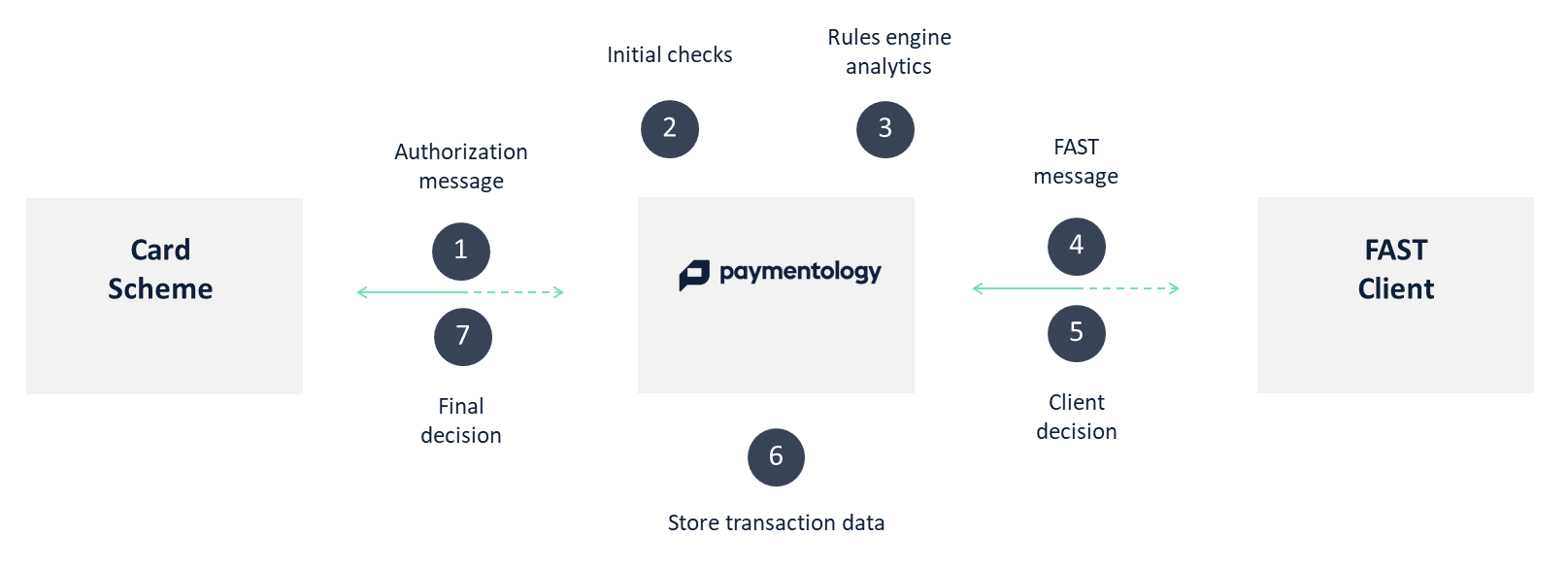
Authorization flow - at time of purchase
The FAST Interface facilitates the transmission of authorization sub-transactions with these steps:
| Step | Description |
|---|---|
| 1 | Paymentology receives authorization message from the relevant card scheme, such as:
|
| 2 | Paymentology performs initial checks on the authorization message, such as:
|
| 3 | Paymentology performs rules engine analytics on the authorization message:
|
| 4 | Paymentology routes the authorization message in the form of a FAST message (ISO 8583 authorization messages with enhanced fields) to the bank |
| 5 | Paymentology receives Retail Bank/Programme Manager decision |
| 6 | Paymentology performs final checks and store financial decision |
Below are the different types of authorization:
External authorization
External authorization is implemented where the client holds the balance of the account and real-time transmission of the FAST Interface messages is required. Banking.Live responds to authorization messages based on non-financial checks, client-defined transaction rules, and the client partakes in the authorization process.
Remote Store of Value products use external authorization
Internal authorization
Internal authorization is implemented where Paymentology holds the balance of the account and no real-time transmission of the FAST Interface messages is required. Banking.Live handles the responses to authorization messages based on financial and non-financial checks as well as client-defined transaction rules.
Local Store of Value products use internal authorization
Passive authorization
Passive authorization can be implemented for both cases where either Paymentology or the client hold the balance of the account.
Preferably, it is used when Paymentology holds the balance of the account; in this case, although the client does not partake in the authorization process, the client is provided with the FAST interface messages in real time. For the case where the client takes part in the authorization process, a FAST interface message can still be sent at the end to notify them.
FAST sample messages
You can find sample authorization messages in the following links:
Updated 11 months ago