
STIP advices
STIP advice transmission
The Banking.Live generated STIP advices, specifically identified by the xx2x identifier, are integral to financial reconciliation, serving a critical function beyond mere notifications.
Far from being simple alerts, these advices (particularly the 0120 message) are the primary mechanism through which you are kept informed about STIP - processed transactions, ensuring you can update your financial records promptly and maintain financial integrity. The careful handling of these advices is imperative, given their significant role in transaction processing.
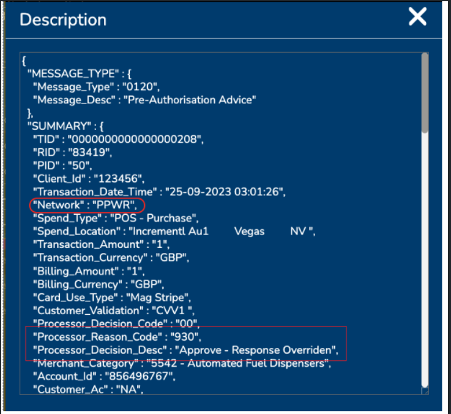
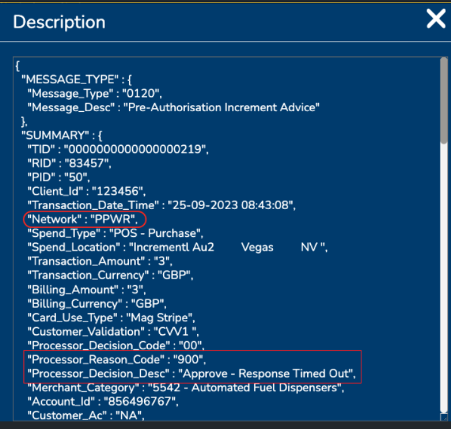
A key feature of the Banking.Live STIP advisement is the designation of the "Network" field as "PPWR". This specific identifier signifies that the advisement originated from Banking.Live, providing clear origin traceability for these messages.
The
"PPWR"marker is crucial, as it distinguishes Banking.Live generated advisements from those generated by Card Networks.
Additionally, Banking.Live distinguishes between STIP advices arising from Timeout and Non-Timeout exceptions through specific reason codes ("Processor_Reason_Code"), maintaining continuity with existing protocols.
"Processor_Reason_Code" | "Processor_Decision_Desc" | STIP event type |
|---|---|---|
| 900 | Response Timed Out | Timeout error related advices |
| 930 | Response Overriden | Non-Timeout related advices |
STIPfor Non-Timeout error:
STIPfor Timeout:
Mitigating duplicate STIP advices
Banking.Live relays messages to your system until a predefined threshold for timeouts is reached within a specified timeframe, leading to your endpoint being designated as throttled. During this period, there's a possibility that messages timed out online might still be processed by your system. To mitigate the risk of duplicate transactions (debits or credits), Paymentology has implemented an enhancement in the STIP FAST message protocol, introducing the original_RID field.
This original_RID field carries the unique identifier of the original transaction that was attempted online but experienced a timeout. The presence of this field signifies that the message was initially sent online and encountered a timeout issue at Paymentology's end.
You are required to check for the existence of this field within incoming messages. Should the original_RID field be present, indicating a previous timeout, and if the TID (transaction ID) and the original RID (record ID) are found to have already been processed, you are instructed not to apply any financial impact based on the advice message. This careful verification process ensures the avoidance of financial discrepancies and maintains the integrity of transaction processing.
FAST STIP advice sample with original_RID
{
    "MESSAGE_TYPE": {
        "Message_Type": "0120",
        "Message_Desc": "Authorisation Advice"
    },
    "SUMMARY": {
        "TID": "0000000000000008779",
        "RID": "83610",
        "PID": "5",
        "Client_Id": "123456",
        "Transaction_Date_Time": "22-04-2024 12:24:07",
        "Network": "PPWR",
        "Spend_Type": "POS - Purchase",
        "Spend_Location": "Contactless MDES no SCAKopavogur ISL",
        "Transaction_Amount": "1",
        "Transaction_Currency": "GBP",
        "Billing_Amount": "NA",
        "Billing_Currency": "GBP",
        "Card_Use_Type": "Contactless Chip",
        "Customer_Validation": "CVV1 + Online Pin ",
        "Processor_Decision_Code": "00",
        "Processor_Reason_Code": "900",
        "Processor_Decision_Desc": "Approve - Response Timed Out",
        "Merchant_Category": "5812 - Eating Places and Restaurants",
        "Account_Id": "138559225",
        "Customer_Ac": "NA",
        "Total_Fee_Bill": "0.0",
        "Original_RID": "83609"
    },
    "PROCESSOR_VALIDATIONS": {
        "Pan_Check": "PASS",
        "Pin_Check": "PASS",
        "Expiry_Check": "PASS",
        "Track_Check": "PASS",
        "CVV_Type": "1",
        "CVV_Check": "PASS",
        "ARQC_Check": "NA",
        "3DS_Check": "NA",
        "Test_Matrix": "2666693980906860986",
        "Test_Results": "0",
        "Rules_Checked": "6399",
        "Rules_Triggered": "",
        "Rules_Decision": "00"
    },
    "ISO_MSG": {
        "DE2": "740552349",
        "DE3_1": "00",
        "DE3_2": "00",
        "DE3_3": "00",
        "DE4": "000000000100",
        "DE7": "1025080801",
        "DE11": "123521",
        "DE12": "080801",
        "DE13": "1025",
        "DE14": "2701",
        "DE18": "5812",
        "DE22": "071",
        "DE32": "005302",
        "DE33": "200196",
        "DE37": "227600123519",
        "DE38": "100863",
        "DE39": "00",
        "DE41": "21600042",
        "DE42": "9082416 ",
        "DE43": "Contactless MDES no SCAKopavogur ISL",
        "DE48": {
            "1": "F",
            "22": "02011",
            "23": "21",
            "61": "00001",
            "33": {
                "1": "H",
                "2": "5456050800986724",
                "3": "2508",
                "6": "50181955855",
                "8": "01"
            },
            "26": "537",
            "30": "rGsvUe6+uj5W4vGNsyNHyOIHl7CO8m5b9H9ddfvsC4k=",
            "27": "0102CI0206OVUOVP",
            "75": "0103001020290",
            "71": "50C 61P 18C"
        },
        "DE49": "826",
        "DE51": "826",
        "DE60": "102",
        "DE61": "0000000000300352200 "
    },
    "RULES": [
        {
            "Rule_Id": 6399,
            "Rule_Type": "Au",
            "Rule_Check_Result": 0,
            "Pattern_Result": false,
            "Current_Txn_Amt_Deviation": 0.0,
            "Aggregate_Deviation": 0.0,
            "Count_Deviation": 0
        }
    ]
}
Responding to STIP advices
STIP messages are treated as advice messages and are generally expected to be accepted. The processing of STIP messages is contingent upon the HTTP response codes received upon submission. Specifically:
- Approval handling: if a STIP message elicits an approved HTTP response code, it is considered to have been successfully processed.
This indicates that the advice message has been effectively communicated and acknowledged without any errors. - Handling of non-approval responses: conversely, if the HTTP response code received does not signify approval, the transaction associated with the STIP message is queued to be picked up during the subsequent execution of the scheduler.
This process continues until the transaction reaches the pre-configured maximum attempt count, known as the exhaust count.
It is important to note that in this context, Banking.Live specifically evaluates HTTP response codes for determining the handling of STIP messages. The "DE39" response code is not utilized in this particular assessment of STIP message processing.
Updated 11 months ago