
Balance listing
Banking.Live offers two distinct methodologies for STIP in relation to balances:
- Balance listing: under this strategy, it is the your responsibility to ensure continuous synchronization of account balances with your system. This persistent balance listing is vital as transactions eligible for STIP are assessed against both the account balance listing and the predefined STIP eligibility criteria.
This method ensures that transactions not only adhere to STIP guidelines but also reflect the financial reality of the account, thus maintaining the integrity of financial transactions. The obligation to keep the balance listings updated in Banking.Live at all times lies with you (as the client). - No balance listing: in this simpler approach, you are not required to constantly update the account balance listings within Banking.Live.
Here, the acceptance of STIP transactions is determined exclusively based on the STIP eligibility rules, without the need to verify the account's balance listing.
This model alleviates the administrative burden by removing the necessity to perpetually align balances between Banking.Live and your system. Consequently, while this approach streamlines the transaction approval process by focusing on compliance with STIP criteria, the responsibility for maintaining updated balance listings does not apply.
Balance listing approach
In the Banking.Live STIP framework, the balance listing approach has specific characteristics aimed at ensuring coherence and efficiency in how balances are recorded:
- Account-level storage: balances are listed at the account level rather than on individual cards or tokens.
This principle recognizes that each card or token should be linked to at least one account, centralizing the balance listing to streamline transactions and monitoring. - Shared balance for linked cards/tokens: in scenarios where multiple cards or tokens are linked to a single account, all these instruments share the same account balance.
This shared approach means that when the balance listing is updated through one of the balance listing methods - it affects all linked cards or tokens equally, reflecting a unified balance across all associated payment methods.
Balance listing methodologies
There are three primary methodologies to ensure the synchronization of account balances with the Banking.Live database:
Best practicesYou can check out our Balance listing - Best practices guide to help keep your balance listing up-to-date and accurate.
Client responsibilities
You are responsible for ensuring that updated balances are communicated to Paymentology. You have four options to fulfil this requirement:
- Online FAST response messages
- Balance update API
- Batch files
- Or by employing all of the above.
During the initial setup phase, you will collaborate with our team to determine the most suitable method for balance updates as well as the frequency of these updates, ensuring a streamlined and effective balance listing process.
Balance listing in PayControl
Balance listing is viewable in PayControl:
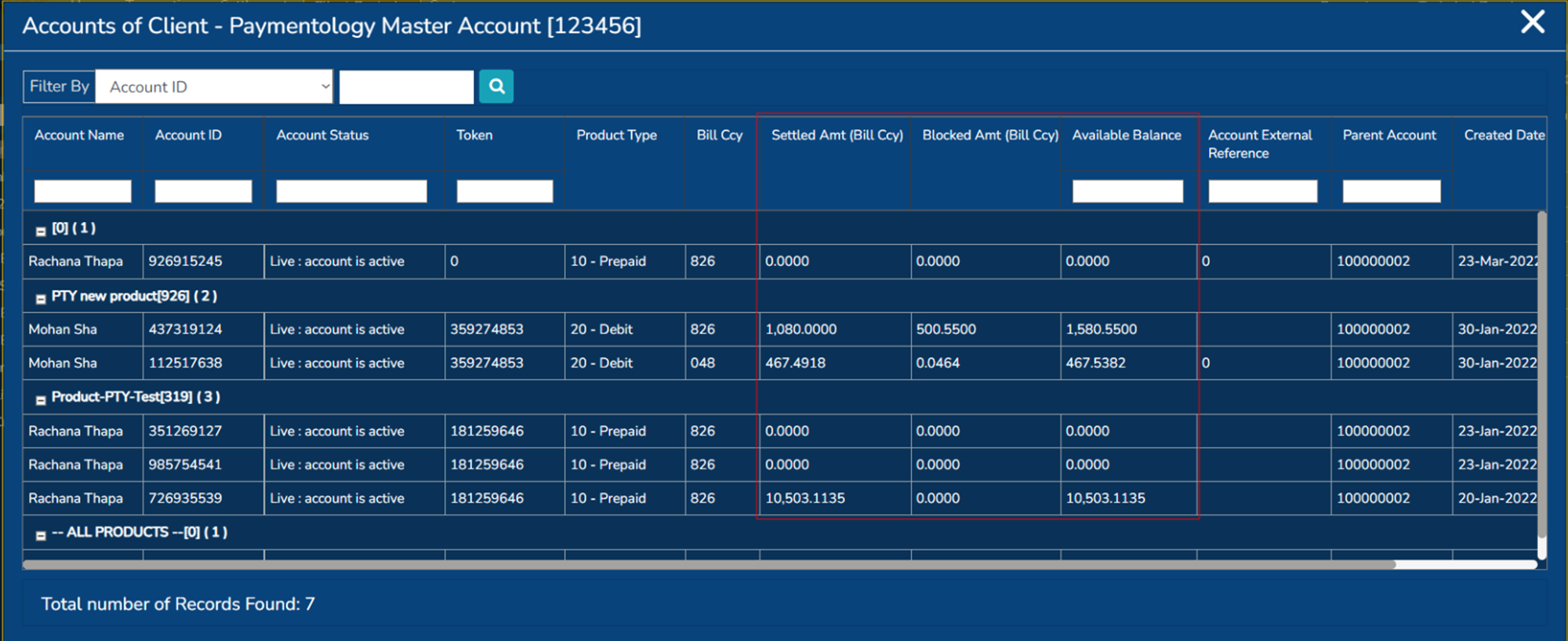
Balance listing in PayControl
Updated 11 months ago