

Lume Token Platform overview
Paymentology's schema-agnostic tokenization platform across all token types

Lume Token is Paymentology's next-generation I-TSP (Issuer-To-Token Service Provider) platform. It consolidates and modernizes how issuers handle digital card tokenization across all card networks and is a core component required by Issuer to enable the digitization (tokenization) of his cards. This guide describes the issuer integration with the Lume Token platform. Terms such as tokenization, payment tokenization and digitization must be considered as equivalent within the scope of this guide.
In simple terms, Lume Token is a configurable "brain" that sits between issuers and the tokenization services of the card schemes (Visa, Mastercard, and emerging domestic schemes such as MADA and Jaywan). It is a suite of on-behalf-of services (OBO) that intelligently decides how each token request is processed using dynamic, rule-based decisioning for token provisioning.
Issuers can define custom business rules on any field of a tokenization request to determine whether to approve, decline, or step-up a token issuance — all through configuration, without writing code.
Key capabilities
- Schema-agnostic rule engine — define rules against the native fields of any card scheme, exposed through one common interface.
- Modular value-added services — switch platform modules on or off based on your needs.
- Integration testing — use the Token Tester and your agreed test plan to support validation and applicable certification activities before going live.
- Identity & verification (ID&V) decisioning — decide which activation methods to offer based on risk signals in the request.
- Decision visibility — use enriched notifications to understand provisioning outcomes and token lifecycle activity.
- Flexible operating modes — use Notification mode for managed decisions and issuer visibility, Full OBO without the decision-event feed, or Advice mode for issuer decisioning.
Concepts and responsibilities
Token Requestor - One of the common roles in payment tokenization ecosystems. Token Requestor or TR-TSP that stands for Token Requestor-To-Token Service Provider is an entity that can request payment tokens and/or use it for payments. All Token Requestors are enrolled, managed and certified by the Token Service Provider. Token Requestor examples could be third-party wallets(e.g. Apple Pay or Google Pay), merchants, e-commerce programs or other payment service providers.
| Token Requestor type | Typical examples | Main use case |
|---|---|---|
| Device Wallet / OEM Wallet | Apple Pay, Google Pay, Samsung Pay | Token stored/provisioned to a consumer device |
| Merchant / Card-on-File | Netflix-like merchant, retailer, subscription service | Merchant replaces stored PAN with network token |
| Digital / E-commerce Wallet | PayPal-like wallet | Credentials stored by a digital wallet for online payments |
| Click to Pay / SRC | Click to Pay / SRC | Network-based e-commerce checkout |
| Issuer Wallet / Issuer App | Bank's own wallet/app | Token stored/provisioned to a wallet inside a banking application |
| Payment Service Provider / Gateway | PSP, payment facilitator, gateway | Tokenization performed for downstream merchants |
| IoT / Connected Device | Wearables, connected devices | Payment credential provisioned to a non-phone device |
| Other registered Token Requestors | Scheme-specific implementations | Any other entity registered with the TSP/network |
TSP - Token Service Provider is the tokenization system responsible for tokenization and de-tokenization of payment data, e.g. VTS for Visa or MDES for Mastercard
I-TSP - Issuer-to-Token Service Provider is the bi-directional integration between Issuer and Token Service Provider. This integration is the enablement of payment tokenization for issuers.
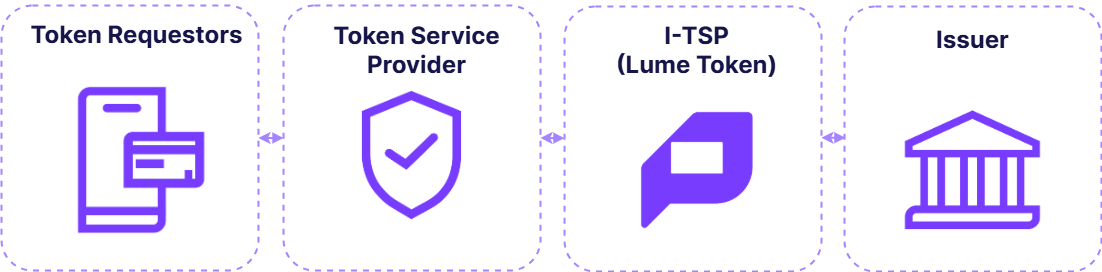
TR-TSP, TSP, ITSP and Issuer setup
Where to next
- How Lume Token works — the architecture and request flow.
- Operating modes — choose your level of control.
- Platform modules — the building blocks of a Lume Token setup.
- Rule engine — how decisioning rules are built and evaluated.
- Supported networks — Visa, Mastercard, MADA, and Jaywan.
Updated 20 days ago